
Talking AI and the Future of Local Councils
Meet the guests





Show notes
This one breaks the usual format. Instead of a single guest, we brought together a panel of people who know the sector — and the tech — to ask a deceptively simple question: if AI keeps developing at its current pace, what does the parish, town, or community council of 2036 actually look like?
It grew out of a collection of short articles that Tom Clay of ERNLLCA pulled together, each contributor giving their take on the impact AI might have over the next ten years. We turned the articles into a roundtable. The result is less a lecture and more a proper conversation — optimism, scepticism, a few jokes, and a lot of practical sense.
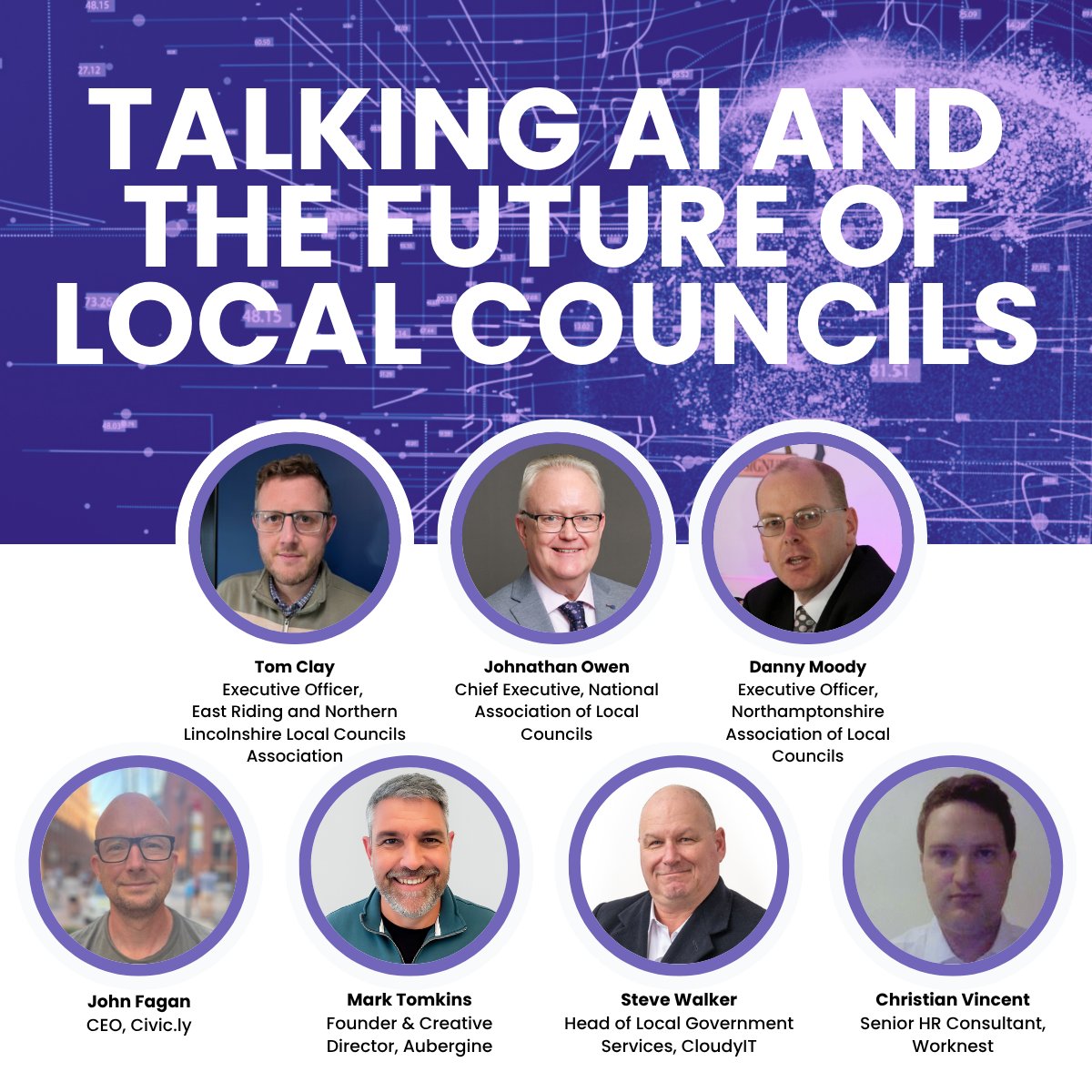
On the panel:
- Jonathan Owen (Chief Executive, NALC) on AI and the future of local democracy — freeing up time, improving engagement, and strengthening the sector's voice.
- Danny Moody (Northamptonshire CALC) with the contrarian view: the clerk's role will change dramatically, residents now wield AI too, and beware the burnout trap of simply doing more tasks.
- John Fagan (Scribe & Civic.ly) on a day in the life of budgeting for the precept — 2025's manual marathon versus a 2035 of finance agents and live dashboards.
- Mark Tomkins (Aubergine) on AI as a tool, not a sci-fi overlord — more like a naughty teenager that needs guardrails, especially around websites, accessibility, and hallucinations.
- Steve Walker (CloudyIT) on why, for some councils, 'tomorrow is today' — and how AI could hand clerks back their evenings.
- Christian Vincent (WorkNest) on the employment angle: AI as a brilliant starter but a dangerous source of truth, and keeping the person in the process.
- Tom Clay (ERNLLCA) rounding up — a small, conservative sector means patchy adoption, but automation is coming regardless; read what the AI makes for you before you trust it.
We close with the questions John put to the panel — do you need to declare that AI wrote something, and how do you handle data and GDPR with tools hosted outside the UK — plus the usual Pod-on-the-Parish intro and outro with Tom, including this episode's Pay-it-Forward.
Chapters
Questions answered in this episode
Drawn from our 'Talking AI and the Future of Local Councils' panel and the questions John put to the speakers. The answers below are editorial summaries of what the panellists said — not verbatim transcripts.
Will AI replace parish and town council clerks?
The panel's consensus was no — but the role will change. AI is already good at the administrative core of the job, so what's left is the genuinely human part: judgment, leadership, and connection to place. Clerks become supervisors and validators of AI tools rather than being replaced by them.
What parts of a clerk's job can AI realistically do today?
Drafting agendas, producing minutes, summarising long reports, first drafts of policies, and handling routine enquiries. These are exactly the repetitive tasks AI handles well — but every output needs a human to check it before it goes anywhere.
Does using AI to save time actually create a burnout risk?
It can. The warning from the panel was that time freed up by AI tends to get refilled with more tasks rather than spent on strategic or community work. Protecting thinking time and professional discretion matters as much as adopting the tools.
Do councils need to state when content or an email was written by AI?
The panel's view was that there's no blanket need to label AI-assisted content if a human has had genuine oversight and checked it — much as you wouldn't declare that you used spellcheck or autocomplete. A disclaimer only really makes sense if something is published unchecked, which you shouldn't be doing anyway.
How do councils protect data and stay GDPR-compliant with AI tools hosted outside the UK?
Treat AI like any other cloud service and read the terms: free plans often train on your inputs, paid plans usually don't. Don't put genuinely sensitive personal data into open tools, UK-hosted and compliant options do exist, and remember everyday tools like email already route data internationally without anyone panicking.
What are AI 'guardrails' and why do they matter?
Guardrails are the boundaries and trusted sources you set so a tool stays on task — 'use only this information, don't do that'. Without them AI hallucinates and makes things up, because its raw source is the whole internet. The panel's analogy: AI is like a naughty teenager that behaves well supervised and causes chaos left alone.
Should a council have an AI policy?
Yes — and it's increasingly relevant to Assertion 10. Rather than a standalone document, weave AI into your existing IT, communications, and safeguarding policies. If you use AI to draft a policy, make sure it actually speaks to your other policies and read it properly rather than assuming it's right from day one.
Is AI a ten-year change, or is it already here for councils?
Both. For some councils 'tomorrow is today' — the tools are already in everyday use. But because the sector is small, conservative, and often short on budget and technical skills, wider and more sophisticated adoption will be patchy, even as background automation of routine tasks becomes near-universal.