
Accounting Basics for Clerks & RFOs (and a Sideline in Playmobil)
Meet the guest
Watch
Get the Video and Slides
Show notes
Stepping into a role that involves public money can feel overwhelming — especially when local council finance comes with its own rules, "proper practices" and terminology that can read like a different language. This episode is the antidote: a friendly, jargon-free walk through the building blocks every Clerk and Responsible Financial Officer needs, pitched squarely at people who are new to the finance side of the role (or want to shore up the fundamentals). As Hannah puts it, you don't need to be a maths whiz — you need to understand the foundations and have the right systems in place.
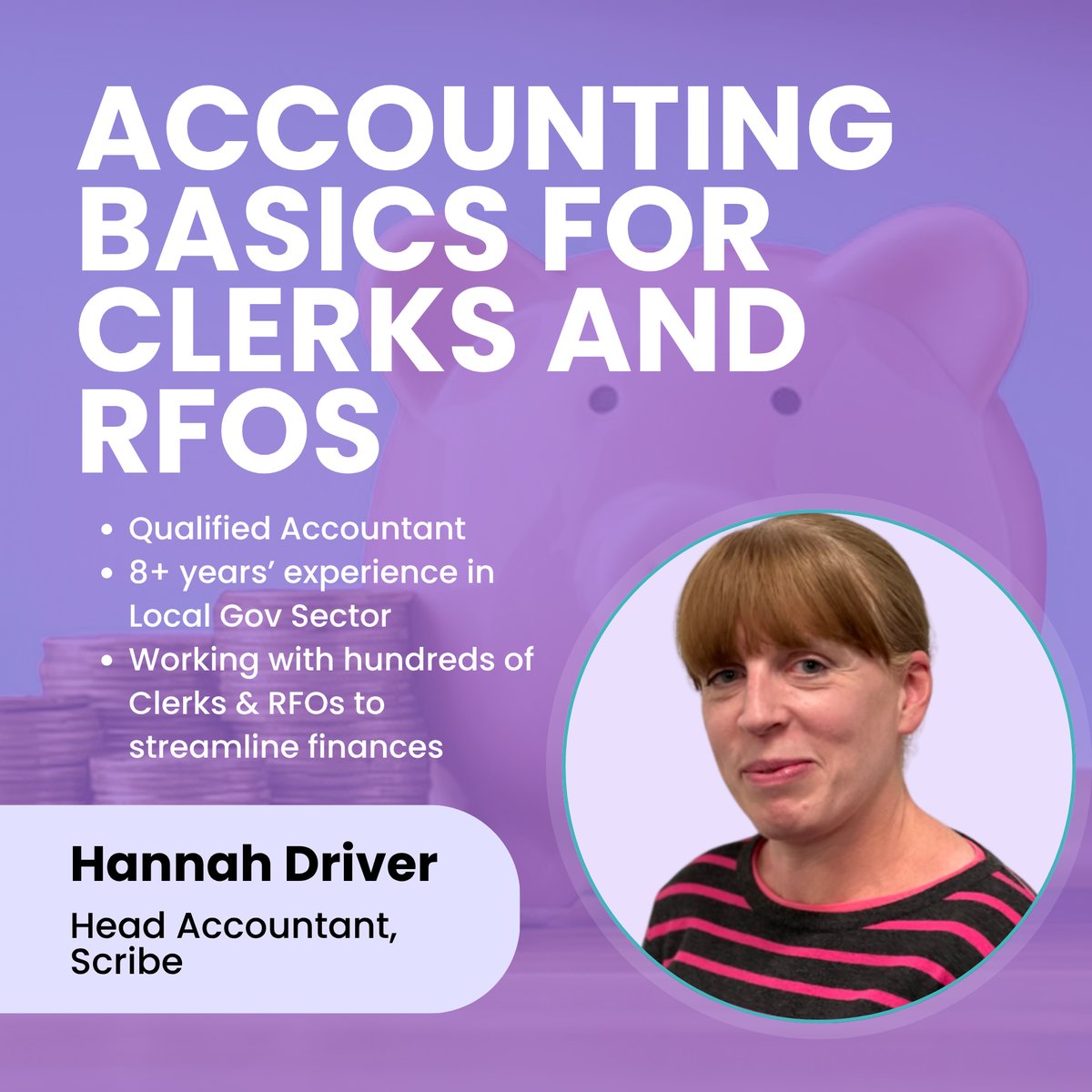
Hannah Driver is Head Accountant at Scribe, where she's spent eight years working day-to-day with parish and town councils of every size. Before Scribe she spent twelve years at Norse, a facilities-management company serving district and county-level councils, and she studied business management (with an accounting bent) at the UEA. Away from the numbers she's a keen fossil hunter — collecting ammonites and jet on the Yorkshire coast — and runs a long-standing Playmobil side hustle, buying, restoring and reselling sets.
The heart of the episode is a whole-year overview of council finance. Hannah starts with what makes council accounting different and the role of the RFO, then clarifies the distinction that trips people up most: receipts and payments (cash accounting — what happened, when it happened) versus income and expenditure (which considers the period a transaction relates to, with debtor and creditor adjustments). If Box 7 and Box 8 on your AGAR match, you're almost certainly in receipts and payments; if they differ, you're in income and expenditure. Councils under £200,000 gross can use receipts and payments; go over for three consecutive years and you must move to income and expenditure (and restate the prior year when you switch).
From there she makes the case that the cashbook is the single most important accounting record a council keeps — do it little and often, split out the VAT, keep a full audit trail of invoices, reconcile to the bank monthly, and structure it around your budget codes so budget-versus-actual reporting is easy. The VAT section covers both non-registered councils (reclaiming via Form 126 on the Government Gateway, whole calendar months, claims going back up to four years) and registered councils (VATable income like a car park, café or bar; the £1,000 output-tax trigger; Making Tax Digital; aligning VAT quarters to 31 March).
Hannah rounds out the practical content with the asset register — the record behind Box 9 (Box 12 in Wales), why there's no depreciation in council accounting, the £1 proxy value for gifted or community assets, and using it to plan renewals — and reserves: a general reserve of roughly three to twelve months' expenditure, earmarked reserves for specific projects and asset renewals, and capital reserves (including the rule that asset-disposal proceeds over £10k must sit in a capital reserve). The golden rule: reserves must be justifiable, not just money sitting in the bank with no plan. The episode also includes a quick overview of the Scribe accounts software from Hannah's colleague India.
In the outro, Hannah's one thing to take away is that almost everything flows from a good, accurate, up-to-date cashbook — get that foundation right and the rest falls into place — plus a gentle bit of advice from her younger self: don't overthink it, don't sweat the small stuff, and try to be happy. She also takes on the Pay-it-Forward question and leaves a cracking one of her own.
Chapters
Questions answered in this episode
Drawn from our conversation with Hannah Driver, Head Accountant at Scribe. The answers below are editorial summaries of points raised in the webinar — not verbatim transcripts, and not formal accounting or tax advice. For a complicated VAT or accounting position, take specialist advice.
What's the difference between receipts and payments and income and expenditure accounting?
Receipts and payments is the simpler, cash-based approach — it records money when it is actually received or paid, regardless of the period it relates to. Income and expenditure considers the period a transaction relates to, using debtor and creditor adjustments. A quick way to tell which you use: on your AGAR accounting statements, if Box 7 (funds carried forward) equals Box 8 (total bank position) you're almost certainly in receipts and payments; if they differ, you're in income and expenditure, with the difference representing the adjustments.
Which accounting approach is my council allowed to use?
Councils with gross income or expenditure under £200,000 in the financial year can use receipts and payments. You only have to move to income and expenditure if you exceed that threshold for three consecutive years — a one-off spike (say a large grant or CIL money) that drops back under again doesn't force a change. You can also choose to use income and expenditure voluntarily while under the threshold, which some councils do when a clerk or councillor has a strong financial background. If you do switch approaches, remember you must restate the prior year so both years shown on the AGAR use the same basis.
Why is the cashbook so important, and how should I keep it?
The cashbook is the single most important accounting record a local council keeps — it's where every transaction in and out is logged, and good information in means good reporting out. Keep it little and often rather than letting it pile up, split out the VAT, keep a full audit trail of approved invoices, and reconcile to the bank at least monthly. Structuring it around your budget codes is key: if transactions are allocated to the right codes you can run budget-versus-actual reports (and answer questions like "how much does the village hall cost us?") easily, rather than wrestling a spreadsheet that bears no resemblance to the budget.
How do non-VAT-registered councils reclaim VAT, and what is Form 126?
A council that isn't VAT registered can still reclaim the VAT it incurs on purchases using Form 126, submitted through the Government Gateway on the HMRC website (if you haven't claimed for a while you may need to start the first one by post). There are no fixed claim dates, but you must claim for complete calendar months; if your claim is under £100 you can only claim annually. Claims can go back up to four years, so it's worth investigating if you've inherited a position where reclaims are out of date. Hannah recommends claiming at least annually and to 31 March, so it dovetails with year-end.
When does a council have to become VAT registered?
Unlike an ordinary business with a £90,000 threshold, a council should register as soon as it has VATable income — typically from a trading activity like a car park, café or bar. In practice HMRC won't enforce registration until that income would generate around £1,000 of output tax (VAT) in a financial year, which guards against one-off items. Once registered you'll submit VAT returns (usually quarterly) through Making Tax Digital software, and it's worth arranging your VAT quarters to end on 31 March so they don't straddle the financial year.
How should VAT coding be handled when there's no VAT — zero, exempt, or out of scope?
The most important thing is recording VAT correctly where it exists (standard or reduced rate). Where there's no VAT and you're unsure, the sensible default is "X" — outside the scope of VAT — which covers things like salaries, the precept, and payments to suppliers who aren't VAT registered. Genuinely zero-rated or exempt items are relatively rare for councils (think books or postage), so when in doubt and no VAT is being charged, out of scope is usually the safe choice.
Are councils with allotments or cemeteries usually VAT registered?
Generally no. Allotments, cemeteries and venue hire are the kinds of activities that don't create a VAT registration requirement — venue hire is typically exempt, for instance. The thing to watch is the recovery of VAT on business activities: if a council carries out significant works such as a large village-hall refurbishment and then hires rooms out, there can be a VAT implication, so it's worth taking specialist advice for anything large or complex.
A councillor bought something on a personal account or the invoice isn't addressed to the council — can we still reclaim the VAT?
This is a grey area. The better practice is to avoid it by getting the council its own debit cards so individuals don't have to buy things personally. Where it does happen, aim to get an invoice addressed to the councillor care of the council so there's a clear record. If all you can get is a shop receipt rather than a formal invoice, that's acceptable provided the receipt shows the supplier's VAT number and the VAT amount you're reclaiming.
Do council assets depreciate, and where is that set out?
No — there is no depreciation in local council accounting. An asset is recorded as a payment (Box 6) when purchased, goes onto the asset register, and simply stays there at its recorded value until it is disposed of; if it's sold, any proceeds show as income (Box 3). This is set out in the Practitioner's Guide (the JPAG guidance). It often surprises people coming from a commercial background where assets are routinely depreciated.
What should the asset register record, and what about gifted or community assets?
At a minimum the asset register should record the date of acquisition, the cost, the location, and the useful life of each asset — and it's worth logging items individually (five benches as five entries, not one) so you can track and maintain them. It underpins Box 9 on the accounting statements (Box 12 in Wales) and your insurance cover. For gifted or community assets with no real resale value — a village pond, for example — a proxy value of £1 is used. Keeping it updated for additions and disposals also feeds reserve and budget planning for future renewals.
How much should a council hold in reserves?
A council's general reserve — there to cover day-to-day running and cash-flow or unexpected events — should typically be equivalent to between three and twelve months' expenditure (smaller councils nearer a full year, larger councils nearer three months). Beyond that, money should sit in earmarked reserves (for specific projects, asset renewals, or things like elections) or capital reserves; note that proceeds over £10k from selling an asset must go into a capital reserve. There's no upper limit on earmarked or capital reserves, but they must be justifiable: holding reserves of more than double your precept with no clear plan will prompt questions.
What should I give councillors alongside the AGAR figures so they can be confident the numbers are right?
Share the supporting evidence you'd send the external auditor. The bank reconciliation is the big one, because it supports Box 8 — a balancing bank rec means the figures feeding in are sound. If you work in income and expenditure, also provide the reconciliation between Box 7 and Box 8 that explains the adjustments. You can run the underlying reports from your accounting software for any specific figures, and giving councillors read-only access lets them review and raise questions before the meeting.
How long does the external auditor take to come back with queries?
There's no fixed timescale — auditors generally work through submissions in the order they arrive, and the statutory deadline for the completion certificate is 30 September, so queries can land at any point up to late September. Last year in particular a lot of feedback came back later than councils expected. The practical takeaway: don't assume an early sign-off, and if queries arrive while you're on leave or working part-time, it's reasonable to manage them on a realistic timescale.