
Career Pathways: From Apprenticeships to CiLCA and Beyond
Meet the guests

Guest
Nigel Hayes
Responsible Financial Officer (RFO)
Dorchester Town Council
Watch
Get the Video and Slides
Show notes
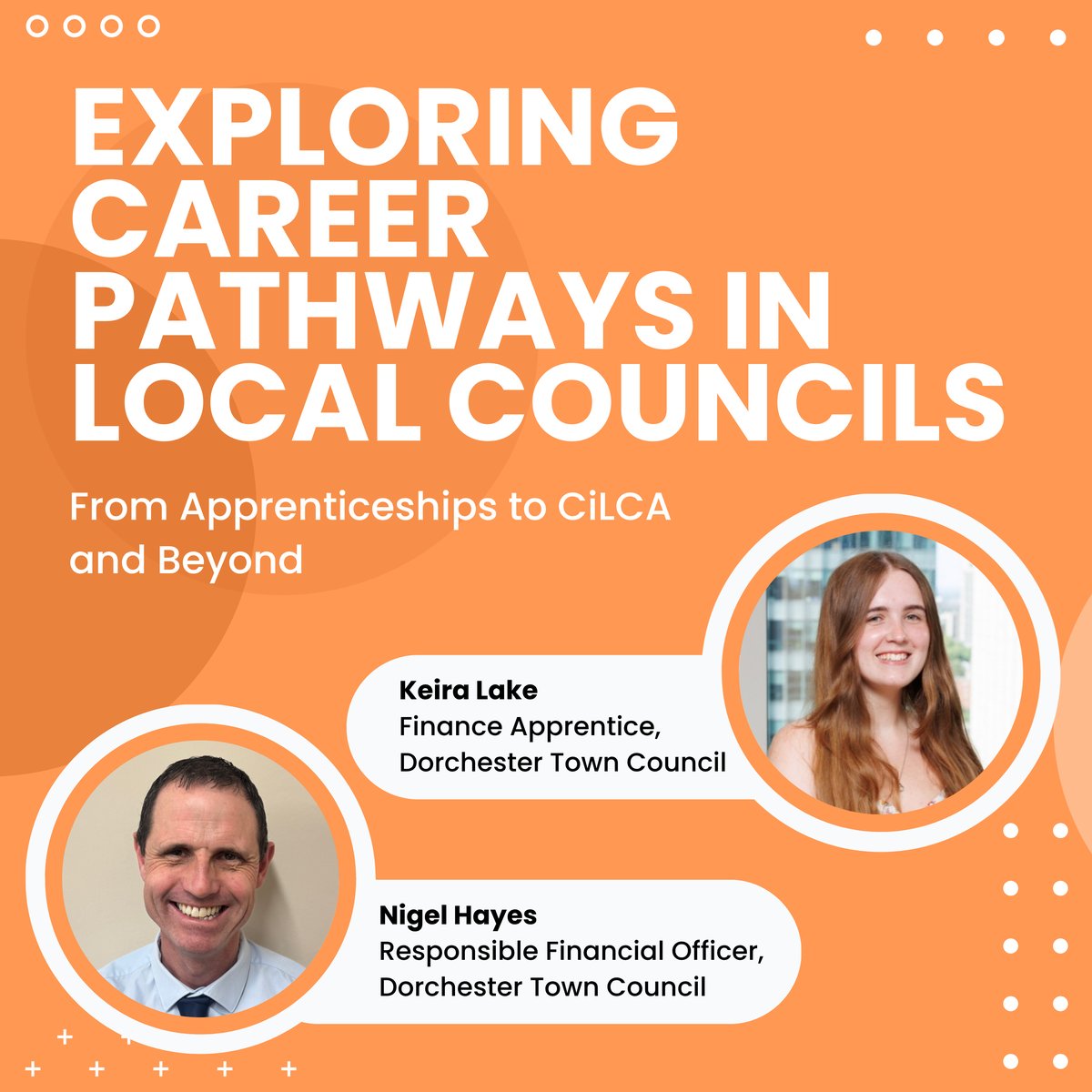
In this episode, John is joined by Nigel Hayes (RFO at Dorchester Town Council) and Keira Lake (Finance Apprentice) to talk about the value of apprenticeships in local government and the full career pathway available to council officers.
Nigel explains why Dorchester went the apprenticeship route — closing the demographic gap in the 20–39 age group, succession planning, and risk mitigation — and walks through the funding available, including apprenticeship levy transfers, government incentive payments, and local grant schemes. Keira shares her experience starting as an 18-year-old apprentice, completing ILCA, FILCA, PIALC, and AAT Level 2, and offers practical tips for the End-Point Assessment.
The conversation covers the full academic pathway from ILCA through CiLCA to the Community Governance degree with De Montfort University, making the case that apprenticeships are a strategic investment, not just a cost.
Plus: does Keira ever sleep? Is Nigel worried she'll take his job? And why he's secretly a director at Dorchester Town FC.
Chapters
Questions answered in this episode
Drawn from our conversation with Keira Lake (Finance Apprentice) and Nigel Hayes (Responsible Financial Officer) at Dorchester Town Council. The answers below are editorial summaries of the discussion — not verbatim transcripts.
Why would a council take on an apprentice rather than recruit a fully qualified candidate?
The strongest case is succession planning. Many councils have a demographic gap in the 20–39 age bracket — staff cluster at either end — and without a younger generation coming through, every senior departure becomes a recruitment crisis. An apprenticeship lets a council grow the experience and qualifications it actually needs around its own systems and culture, rather than competing in a thin external market when a key role suddenly opens up.
What funding is available to local councils for apprenticeships?
A few routes layer on top of each other. The apprenticeship levy is paid by large employers (those with a wage bill over £3 million), and unused funds can be transferred to other public bodies — including parish and town councils. The principal authority is the obvious place to ask: Dorchester Town Council, for example, has had its training fully funded through transfers from Dorset Council. On top of that there's a £1,000 government incentive for taking on a young apprentice (previously £3,000 during the post-COVID push), and many local areas run their own apprenticeship grants. Between them, the direct training cost to a small council can be zero.
What does it actually cost to employ an apprentice?
The apprentice wage is the main cost, alongside employer National Insurance and pension contributions. From April 2025 the apprenticeship hourly rate runs from around £8 for younger starters up to £12.71 for those aged 21 and over — a step-change from the £4.30 starting rate of 2022. When training is fully funded through a levy transfer there's no separate employer-side training fee to budget for. Compared with a standard entry-level grade (e.g. scale point 4), an apprentice is competitively priced while gaining a recognised qualification on the job.
How do councils recruit an apprentice — is it the same as a normal job advert?
The standard route is the government's Apprenticeship Service, usually run through a training provider who advertises the role on the council's behalf. Partnering with a local college that runs the qualification gives the council a steady candidate pipeline. The framing of the advert matters: a finance apprenticeship with an AAT qualification attached typically pulls strong applications, where a more generic "admin apprentice" often doesn't.
Does an apprenticeship have to be a full-time role?
No. Apprenticeships can be part-time, which makes them workable for very small councils where every other role is also part-time. The two requirements that matter are that the apprentice spends roughly one day a week in off-the-job learning (typically at college), and that there's someone in the office to support them rather than them being left to work alone. Beyond that, the contract can flex around the council's existing hours.
Why was AAT chosen for the apprenticeship rather than a council-specific qualification?
AAT gives a broad grounding in finance — invoicing, ledgers, reconciliations, payroll basics — that maps neatly onto the day-to-day work of a council finance team. It isn't council-specific, but a recognised qualification like AAT makes the role appealing to candidates who haven't yet decided on a sector, and it's transferable in both directions if their career takes them elsewhere. Sector-specific qualifications like ILCA, FILCA and CiLCA then layer on top.
How much paid study time should a council give an apprentice or studying officer?
There's no fixed rule, and a written study-time policy isn't required. A common approach is one full day a week at college for the apprentice, plus additional time off in the run-up to exams. For other staff studying qualifications like the Community Governance degree, the training provider allocates study days that translate into office time, with the expectation that some additional work happens at home. Making the expectation explicit at the start tends to work better than imposing a fixed weekly allocation.
What is the qualifications pathway for a local council officer?
The sector has a fairly clear ladder. ILCA — the Introduction to Local Council Administration — is the entry point, followed by FILCA (a deeper foundation, finance-angled), then PIALC (the SLCC internal auditing qualification), and CiLCA, the Certificate in Local Council Administration, which is the recognised practitioner cornerstone. From there, the Community Governance degree delivered by SLCC and De Montfort University runs across three levels of two years each, with exit points after each level so it doesn't have to be a single six-year commitment. A Master's in Public Leadership sits above the degree and is growing in popularity.
Is an apprenticeship a better choice than university for a finance career?
For someone certain they want to work in finance, the maths often favours the apprenticeship. Earning a salary while studying — rather than paying tuition and accruing debt — leaves a meaningful financial gap by the time the qualification finishes, and AAT is recognised by employers across sectors. The trade-off is the university experience, social and otherwise. Apprenticeships suit candidates who already know roughly what they want to do; degrees still make sense where someone wants the optionality of three years to figure that out.
What's the best preparation for the End-Point Assessment (EPA) at the end of an AAT apprenticeship?
Start tracking the requirements from day one rather than waiting for the assessment window. The big one is logging off-the-job hours as you go: AAT Level 2 currently requires at least 278 off-the-job hours and 365 days with the college before the EPA can begin, and discovering a 100-hour shortfall at the last minute is the classic way to delay an exam. Familiarise yourself with the EPA structure early — for AAT that's a one-hour structured interview covering knowledge, skills and behaviours like communication, sustainability and equality — and ask the training provider in advance about the reset and retake policy.
What does an apprentice's day-to-day work actually look like?
At Dorchester it started narrowly and broadened over time. The first stretch was mostly invoices and payment runs — repeatable work that builds up speed and accuracy. From there it widened to month-end tasks (bank reconciliations, direct-debit authorisations, credit-card processing), drafting documents that the RFO reviews before they go out, and one-off projects across other departments. The principle is to hand over a section of work, let the apprentice own it, then layer the next section on top — rather than dumping everything on day one.