
Surviving the Year-End Crunch
Meet the guest
Watch
Get the Video and Slides
Show notes
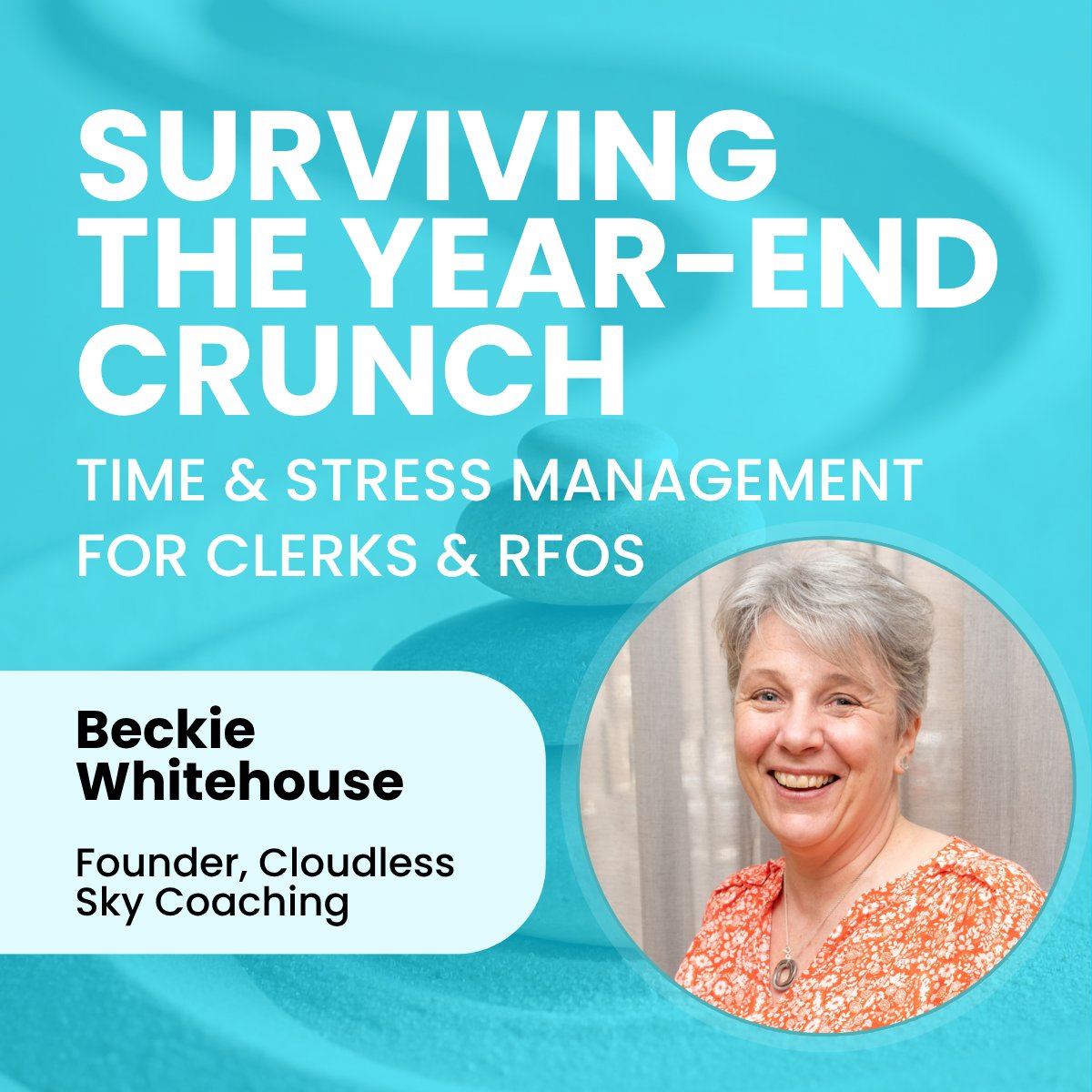
Beckie Whitehouse joins the podcast for a deliberately different kind of year-end episode — not the AGAR-and-bank-rec mechanics, but the bit nobody talks about: keeping your head, your boundaries, and your evenings while the auditor's calling, the inbox is on fire, and someone in the parish has a "quick question" about a swing set. Beckie is the founder of Cloudless Sky Coaching, but she's also a Parish Clerk of fourteen years, which is what makes her advice land — every story is from inside the role, not from a productivity guru's TED talk.
She works through the musts, shoulds, and coulds (and why "should" comes loaded with too much guilt to be useful); time-blocking with realistic buffer for the day a swing breaks; the three-task rule for an inbox that won't stop; and setting boundaries with members of the public, councillors, and chairs without sounding rude — the "I'll come back to you" reply, what to do when the chair calls on a Sunday, and the conversation to have with HR if the extra hours are running away from you. Then mindset: brains as magnets, the gratitude reset, "today I choose to" rather than "today I have to", the stress cycle, the 60-second exhale, and the small movement habits that actually finish a stress response rather than parking it.
It closes with one of the best reframes on the podcast so far — Beckie's 50p story, and the headline she'd like every clerk to take home: you don't have to do everything perfectly to get through year-end well. Plus pay-it-forward: Beckie's answer to Mark Tomkins's hobby question, and a new question for the next guest that John has already pre-warned needs a bit of thinking time. Recorded April 2026.
Chapters
Questions answered in this episode
Drawn from our conversation with Beckie Whitehouse, Founder of Cloudless Sky Coaching and a parish clerk of fourteen years. The answers below are editorial summaries of the discussion — not verbatim transcripts.
Why does year-end feel so much more stressful than the rest of the year?
Three things pile up at once. Pressure — partly from the council, partly self-imposed — about the deadlines that genuinely matter (legal dates, AGAR, audit prep). Capacity, because most clerks aren't full-time and the role doesn't expand to match the season. And perception: telling yourself it's going to be a difficult time will almost always make it one. There's a real pattern of clerks resigning in the summer, just after audit, which is what makes this worth paying attention to rather than just gritting your teeth through it.
How do I prioritise when everything on the to-do list feels urgent?
Sort each task into three buckets: musts, shoulds, and coulds. Musts are non-negotiable — legal deadlines, audit requirements, the dates that don't move. Shoulds are important but flexible (and "should" tends to come loaded with guilt, so be careful not to let everything drift in there). Coulds are the nice-to-haves: the pretty border on the AGM poster, the extra polish. When the week is full, hold the line on musts, do the shoulds well enough, and let the coulds go. Good enough really is good enough.
What's the best way to use time-blocking when life keeps interrupting?
The principle is to protect one or two non-negotiable focus slots in your day — turn off notifications, send the phone to voicemail, close the door — and then accept that the rest of the day will be reactive. The block itself can be whatever shape works for you: an hour, a Pomodoro 25-on / 5-off, whatever lets you concentrate. The mistake is over-engineering the calendar, then having a swing break at 10am and resenting the whole day. Build in genuine buffer time, because the swing always breaks.
How many tasks should I aim to get done in a working day?
Three. At the start of the day (or the evening before) pick three priorities; anything beyond that is a bonus. A long to-do list creates its own kind of paralysis — you stare at it, can't decide where to begin, ask three people what's most important and get three different answers. Choosing three keeps the day moving and protects against the running-on-fumes feeling at 5pm of having worked hard but not finished anything.
How do I tell a councillor or member of staff I can't be interrupted right now?
Be explicit and short. *"This morning I'm working on X — I won't be answering the phone or replying to messages, but I'll come back to you this afternoon."* People are far more accommodating than clerks tend to expect, as long as the boundary is clearly set and the commitment to come back is genuinely kept. Some version of *"I'll come back to you"* is the phrase to keep ready — it's gentle, it doesn't reject the request, and it buys back the focus the work actually needs.
My hours are creeping up at year-end — how do I have a fair conversation with my council about it?
Start by being honest with the council about what you're actually putting in. One common arrangement is to keep a record of the extra hours during busy months (March, April, audit, extra meetings) and balance them back in the quieter months (August is the classic). Most councils, once they see the real numbers, are happy with that. If the hours aren't balancing out year-on-year, that's the moment to bring it to the council, the HR committee, or whatever staffing arrangement your council uses — not to grit your teeth for another season.
Someone wants something from me right now — what's a polite way to push back?
*"I'd love to help — can I come back to you this afternoon / tomorrow / Monday, once I've finished X?"* That single sentence does most of the work. People generally don't mind waiting if there's a clear reason and a clear time. Note it down so you actually do come back; if something slips, message them again ("I'm still working on it, I'll be back to you by Wednesday"). Members of the public are often more grateful than expected — even if the answer is "I have to point you elsewhere", the fact of being come back to at all is the rare part.
How do I stop my brain spiralling into worst-case thinking during a busy month?
Brains work a bit like magnets — they look for evidence to prove whatever you've told them. Wake up thinking "this is going to be a terrible day" and your brain quietly notices every irritation: the rain, the driver who cuts you up, the email that doesn't reply. Switch the framing in the morning — even just listing three small things to be thankful for — and the same brain starts noticing the small wins instead. It feels almost too simple to count as a technique, but it leans against a real evolutionary bias toward looking for threats.
What's a quick mental reframe I can use when the to-do list feels overwhelming?
Swap "today I have to..." for "today I choose to...". It's a tiny linguistic shift that makes a surprisingly large difference. "Have to" implies pressure and no agency; "choose to" returns the sense of control. The same trick works for "I have to do everything" — reframe to "I will prioritise what matters most" or "I'll ask my assistant clerk to take this one." Each version reduces the load slightly without changing what actually needs doing.
What is the stress cycle, and why does it need to be "completed"?
A stressful trigger fires off the body's old fight-flight-freeze-fawn response — the same one that used to help us run from a sabre-toothed beastie. The problem is, modern stress rarely involves running from anything, so the physical response gets stuck in the body. If it isn't released, it carries forward into the rest of the day, the week, the sleep that won't come. "Completing the cycle" means giving the body a small physical signal that the danger is over — a few minutes of movement, a deep exhale, a stretch — so the stress response actually finishes rather than just being pushed down.
What's a quick reset I can do at my desk between two stressful tasks?
Three things, all about a minute each. Breathe in for a count of four and out for a count of six (a longer exhale than inhale signals "safe" to the nervous system). Shake out tension — the way a dog literally shakes itself off after a tense encounter — or, more office-appropriately, drop your shoulders from where they've crept up by your ears, and stretch. Then name what you're feeling, out loud or in your head: *"I'm feeling overwhelmed; this feels too much today."* Naming it tends to take some of the power out of it.
I'm a perfectionist and I'm wearing myself out over a small accounting error. Is that worth it?
Almost certainly not. The story of the missing 50p — hours spent hunting it down, only to be gently told by a councillor that finding it would cost the council more in clerk-hours than the 50p was worth — is one most clerks have a version of. Year-end isn't graded on perfection; the AGAR can be crossed out and amended in front of the internal auditor and nobody ever comes back to say "you made a mistake on the form" if the figures all work out in the end. The headline is worth keeping pinned up somewhere: you don't have to do everything perfectly to get through year-end well.